QuoteStak

For community associations in Washington

The capital-project decision your board can defend.
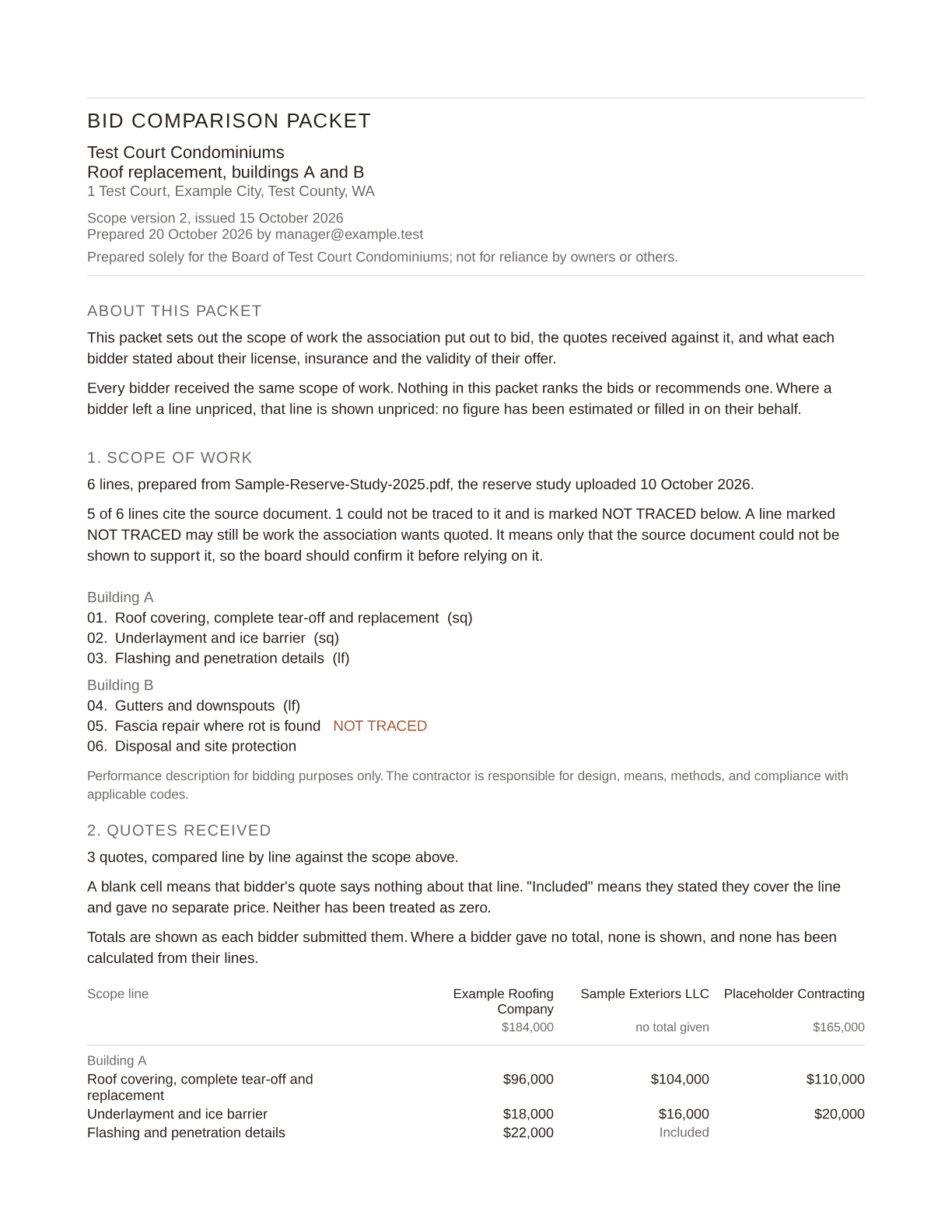
Sooner or later the reserve study comes due: a roof, siding, paving. Six figures of owners’ money, sometimes a special assessment. The board gathers three proposals in three formats, each answering a different question, and then has to pick one. And it has to be able to show how it picked, at the annual meeting, or years later, to an owner who wasn’t in the room.

QuoteStak turns that project into one scope of work, bids a board can actually compare, and a packet that goes into the minutes as the record of how the decision was made. Nothing is ranked and nothing is recommended. The decision is the board’s, and so is the contract.

The first page of a sample bid comparison packet, showing the scope of work and three quotes beside it.
Sample: illustrative data. No real association, contractor or property appears in it.

How an engagement runs

What it costs, and how it runs

A flat $995 documentation fee per project, whatever the project’s size. No contractor pays QuoteStak anything.

1

You hand over the documents

The reserve study, any requirements, photos, and your own list of contractors to invite. QuoteStak writes the scope of work from those documents as outcomes: what gets replaced, matching what's there. Like-for-like replacements only; where a project touches structure, fire-rated assemblies, or egress, that scope needs a licensed design professional, and we will say so rather than write it.

2

Every bidder answers the same question

The board sends the invitations. Each bidder prices the same scope, line by line, on one standardized worksheet, and leaves blank what they don't cover. A blank stays blank: nothing is filled in, averaged, or estimated on a bidder's behalf. Each quote arrives as a written offer held open to the association for 45 days.

3

The board reads one page

The quotes line up against the scope, including the lines nobody priced. That is usually the most useful thing on the page, and the thing three proposals in three formats hides. The packet follows within days of your quote deadline.

What the board receives

A document that can go into the minutes as it is.

Boards are spending other people’s money and have to be able to show how the decision was made, sometimes years later. So the packet is built to be read by somebody who was not in the room: it states what was sent, what came back, and what QuoteStak did and did not do.

  • The scope of work that went out, and which document it was prepared from.
  • Every bidder who was invited, when the invitation was sent, and what came back.
  • Each quote, line by line against that scope, with unpriced lines shown unpriced.
  • What each bidder stated about their license, their insurance, and how long their price stands.
  • Which lines the source document supports, and which could not be traced to it.
  • A signature block, because the board is adopting a record, not reading a brochure.

Built to be relied on

Why a board can rely on the comparison

No one can buy a position

No contractor pays QuoteStak anything: not for a listing, not for a lead, not for a place in the comparison. There is no arrangement under which a bidder could buy a better position, because there is no position to buy.

Nothing is ranked or recommended

No bidder is scored or put forward as the best one. The packet carries no such mark anywhere in it, and the board votes on what it reads.

Your contract is yours

The association contracts directly with the contractor it chooses. QuoteStak writes the scope, collects the quotes, and assembles the record; it is not a party to the work or the agreement.

Stated and checked are labeled apart

Where the L&I registry was checked, the packet says what the registry showed and on what date, with a link to the source. Everything a bidder merely stated, insurance included, is labeled as stated by that bidder, with a reminder to recheck before any contract is signed.

Start a conversation

Tell us about the work, and who is deciding.

A board member or a managing agent can ask here. The reply comes from a person and says whether this fits the work you described. If it does not, it will say that instead.

No sales call. One reply from a person, saying whether this fits the work you described.

QuoteStak uses cookies for sign-in and to save your progress. Privacy Policy